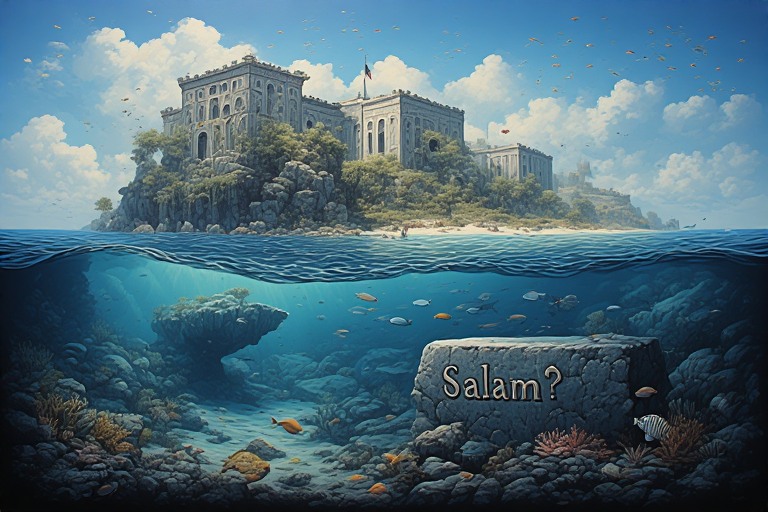
Assalamu’alaikum Warahmatullahi Wabarakatuh
Bismillahir-Rahmanir- Rahim
1. Introduction
Epistemologically, human knowledge has limits. Our eyes can only see a certain spectrum of light, and our ears can only hear certain frequencies. The same applies to reason. Reason is an extraordinary instrument Allah gave us to verify truth.
The task of reason is to test: “Is it true that this universe has a Creator? Is it true that the Qur’an is a miracle?” But once reason concludes that the Qur’an is the absolutely true word of Allah, then, scientifically, reason must also acknowledge the realm of the _“Meta-Rational”_—things that are true yet lie beyond the radar of human logic. This is where faith operates, not to oppose reason, but to perfect what reason cannot reach.
2. Explanation
Qur’anic and Hadith Evidence
A. On the trait of believers regarding the unseen:
الَّذِينَ يُؤْمِنُونَ بِالْغَيْبِ وَيُقِيمُونَ الصَّلَاةَ وَمِمَّا رَزَقْنَاهُمْ يُنفِقُونَ
“[They are] those who believe in the unseen, establish prayer, and spend out of what We have provided for them.” (Surah Al-Baqarah: 3)B. On revelation that is absolutely true:
أَلَمْ تَرَ كَيْفَ فَعَلَ رَبُّكَ بِأَصْحَابِ الْفِيلِ
“Have you not seen how your Lord dealt with the Army of the Elephant?” (Surah Al-Fil: 1)
(Note: This verse uses the word “seen” for a past event, because news from Allah has the same degree of certainty as seeing it firsthand.)C. Hadith about _Sam‘na wa Atha‘na_—“We hear and we obey”:
إِنَّ اللَّهَ كَتَبَ الْإِحْسَانَ عَلَى كُلِّ شَيْءٍ
“Indeed, Allah has prescribed excellence in all things.” (HR. Muslim)[ihsan]
3. Lessons and Message
Faith is not blind naivety, but “Humble Intellectualism.” The moral message is: do not be arrogant with your limited reason. If we reject the news of revelation simply because it seems irrational now, we are actually imprisoning ourselves in the narrowness of our own understanding. Full trust in revelation after rational verification is the highest form of intellectual honesty.Let us recall the moment of Isra’ Mi‘raj. When the Messenger of Allah told of his overnight journey to Baitul Maqdis and the heavens, the people of Mecca laughed at him, deeming it illogical. But look at Abu Bakr As-Siddiq. He did not ask “how?” but asked: “Did Muhammad say it? If he truly said it, then I believe even more than that.” This is a moving faith; a faith that does not hinge truth on the logic of the journey, but on the truthfulness of the one who brought the news.Imagine you are gravely ill and go to the most brilliant expert doctor in the world. After your reason is convinced he is an honest expert through his credentials and testimonials, the doctor gives you a bitter pill and says, “Take this, it will repair the cells in your heart.” Would you dissect the pill and study its atoms yourself just to make it “make sense” to you? Of course not. You take it because you trust the doctor’s authority. The Qur’an is the prescription from the Creator of reason, so obeying its contents is an entirely rational act.There was a person who refused to believe in the realm of the barzakh because, he said, “I dug up a grave yesterday, but there was no garden of Paradise or pit of Hell there.” A scholar answered with a smile, “Try sleeping next to someone who is dreaming of being chased by a tiger. You see him sweating and terrified, yet to your eyes he is just lying down. If your reason cannot even see what the person beside you is experiencing in a dream, how can you expect to peek into the matters of the Hereafter with just a hoe?”
4. Conclusion
My friend, reason is a lamp, but revelation is the sun. Reason helps us step toward the door of truth, but once that door is open, let revelation guide us further. The relevance of our faith in the unseen is a test of love. If we believe in Allah, then we believe in all His news—whether about stars that chase devils or about Paradise that awaits us. Let us close our eyes to doubt, and open our hearts to the certainty of revelation.
والله أعلم بالصواب
الحمد لله رب العالمين
Wassalamu’alaikum Warahmaullahi Wabarakatuh.
ِAbu Sultan Al-Qadrie